



The History of Central Air Conditioning for Homes
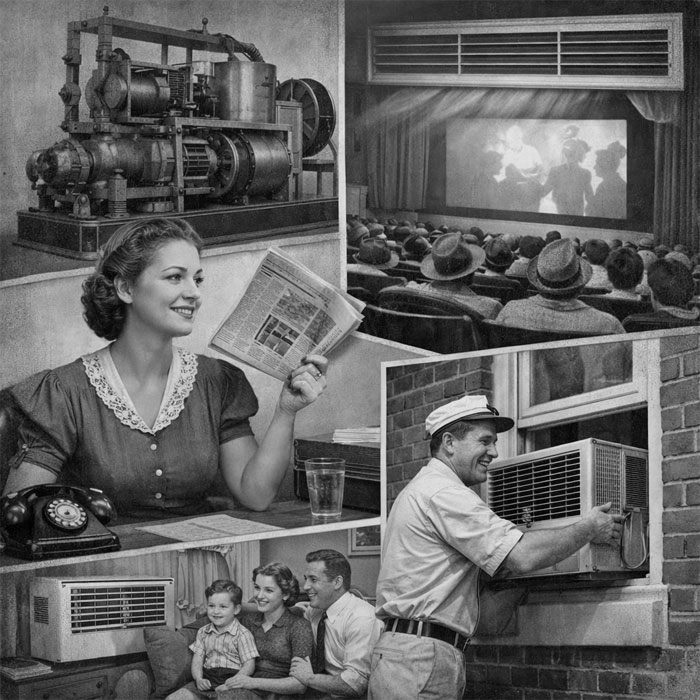
Residential central air conditioning developed steadily from early mechanical cooling into a standard home system, shaped by engineering advances, postwar housing growth, changing refrigerants, efficiency rules, and evolving comfort needs.
How Homes Were Cooled Before Central Air Conditioning
Long before central air conditioning became common, people relied on building design, shade, natural ventilation, fans, and ice to make hot weather easier to handle. High ceilings, porches, shutters, transom windows, and cross ventilation helped warm air move out and cooler air move through a house. Electric fans became another useful tool as household electricity spread.
Mechanical cooling developed during the nineteenth century, largely through work connected with refrigeration. Florida physician John Gorrie built an ice-making machine and received a patent in 1851. His work didn't lead directly to the residential central systems used later, yet it helped advance the broader idea that machines could cool indoor air rather than relying entirely on naturally produced ice.
Modern air conditioning took a major step forward in 1902, when engineer Willis Carrier designed a system for the Sackett & Wilhelms printing plant in Brooklyn. The plant's main problem was humidity, which caused paper to change size and interfered with printing. Carrier's system used cooling coils to control moisture and temperature. He later received a patent for his "Apparatus for Treating Air" in 1906.
Early air conditioning was mainly used in factories, public buildings, theaters, stores, and other commercial settings. Smaller room units appeared later and gave homeowners another option. Window air conditioners became especially important because they let families cool one room without installing a whole-house system. That approach remained common for decades and still serves many homes today.
The First Steps Toward Residential Central Air
Bringing air conditioning into private homes presented a different set of problems. Industrial systems were large, costly, and designed for buildings where mechanical equipment could take up considerable room. A house needed smaller equipment, simpler controls, quieter operation, and a way to distribute cooled air from room to room.
One early landmark came in 1914, when air conditioning was installed in the Charles Gates mansion in Minneapolis. Carrier identifies this as its first residential application. The system was far beyond the budget and needs of the average family, but it showed that whole-house cooling could work in a residence.
Carrier introduced a home air conditioner in 1926, another step toward residential use. During this period, engineers were also improving compressors, refrigerant handling, fans, controls, and duct-based air distribution. These changes gradually made smaller installations possible.
Still, residential central air remained unusual through the 1920s and 1930s. Equipment was expensive, the nation went through the Great Depression, and many houses hadn't been built with mechanical cooling in mind. Room air conditioners were easier to add to an existing house because they didn't require a full duct system.
Postwar Housing Helped Central Air Spread
Residential air conditioning gained stronger momentum after 1945. The United States entered a huge period of home construction, suburban growth, rising household incomes, and widespread use of modern appliances. Builders were putting up large numbers of houses, which gave heating and cooling companies a chance to incorporate mechanical systems during construction.
Installing ducts while a house was being built was easier than adding them after walls and ceilings were finished. Builders could plan equipment locations, duct routes, return-air paths, and electrical service as part of the house itself.
Manufacturing also improved. Equipment became smaller, more dependable, and less costly relative to earlier systems. As production increased, central air began moving beyond wealthy households and custom homes.
A telling milestone came in 1956, when Carrier announced a major residential air-conditioning contract with Levitt & Sons, one of the best-known large-scale home builders of the postwar era. That type of project showed how air conditioning was becoming connected with mass-produced suburban housing rather than isolated luxury installations.
The shift didn't happen everywhere at the same pace. Climate, household income, local building styles, electricity costs, and the age of the housing stock all played a part. Central air naturally had greater appeal in hot and humid parts of the country, while many homes in cooler regions continued using fans or room units.
When Central Air Became a Common Home Feature
By the second half of the twentieth century, central air conditioning was moving steadily into mainstream residential construction. New houses were increasingly designed around mechanical heating and cooling, and buyers began to view central air as a normal household feature.
This change altered the way homes were built and used. Older houses had frequently depended on porches, large operable windows, cross breezes, attic ventilation, and other passive cooling methods. With central air, builders had greater freedom in floor plans and window placement because indoor comfort depended less heavily on natural airflow.
Daily habits changed as well. Families could keep windows closed during hot weather while maintaining a steady indoor temperature. Sleeping, cooking, household chores, and indoor recreation became easier during long stretches of heat and humidity.
Central cooling also supported population growth in warmer parts of the United States. Air conditioning made year-round indoor comfort easier in regions with long, hot summers, helping offices, stores, factories, and homes operate with less disruption from heat.
Residential central air eventually became closely tied to the suburban house itself. The outdoor condensing unit, indoor furnace or air handler, thermostat, supply ducts, and return ducts became familiar parts of home construction.
Better Equipment Changed Residential Systems
The central air systems installed in the 1950s and 1960s were far less refined than many current models. Over time, manufacturers improved nearly every major component.
Compressors became more efficient and dependable. Fan motors improved. Heat-transfer coils were redesigned. Thermostats became more accurate. Cabinet construction and sound control reduced noise. Electrical controls grew more sophisticated, and installers gained better methods for sizing and balancing systems.
System sizing became an important part of residential performance. A unit with too little cooling capacity can struggle during hot weather, while an oversized unit can cool the house quickly and shut off before removing enough humidity. Proper sizing helps the equipment run for suitable cycles while controlling both temperature and moisture.
Duct design also gained greater attention. Leaky, undersized, poorly insulated, or badly routed ducts can waste energy and leave rooms with uneven temperatures. Better installation methods helped homeowners get more useful cooling from the equipment they already had.
Thermostats followed their own long path. Early controls were simple mechanical devices. Programmable thermostats later allowed households to schedule temperature changes during the day. Smart thermostats added remote access, learning features, usage data, and connections with other home systems.
Energy Efficiency Became a Bigger Concern
Early central air systems were judged mainly by how well they cooled a house. By the 1970s, energy use had become a bigger concern as air conditioning became more common and electricity demand increased.
Federal efficiency standards began shaping residential air conditioners in the late 1980s and early 1990s. These rules pushed manufacturers to make systems that used less electricity while still providing reliable cooling.
Over the years, central air conditioners gained better compressors, coils, motors, and controls. Newer efficiency standards followed in 2006, 2015, and 2023, gradually raising the minimum performance required for new equipment.
Modern systems may also use multi-stage or variable-speed technology. These systems can run at lower power when less cooling is needed, which can help keep temperatures steadier and improve humidity control.
Refrigerants Changed With Environmental Rules
Refrigerants have played an important role in the history of central air conditioning because they're the substances that help remove heat from inside a home.
For many years, residential systems commonly used R-22. It worked well, but it was later found to harm the ozone layer. The United States gradually phased it out, and production and import of new R-22 ended in 2020.
As R-22 disappeared from new systems, R-410A became the common replacement. It didn't damage the ozone layer, but it was later found to contribute more heavily to global warming.
Beginning in the 2020s, the industry started another change. Newer refrigerants such as R-454B and R-32 began replacing R-410A in many new central air systems because they have a lower environmental impact.
These changes show how central air conditioning has continued to evolve as environmental concerns and federal rules have changed.
How Central Air Conditioning Changed the American Home
Central air conditioning influenced the entire home, well beyond the mechanical room. It changed architecture, household routines, regional growth, and the way people viewed summer comfort.
Houses no longer had to rely as heavily on window placement and natural breezes for relief from heat. Screened porches and sleeping porches became less important for cooling. Windows could remain closed through much of the summer, which also reduced outdoor noise, pollen, dust, and insects entering the house.
Central air affected where people spent time indoors. Rooms that had once become uncomfortable during hot afternoons could remain usable throughout the day. Upper floors became easier to cool, though proper duct design remained important for balanced temperatures.
The technology also changed what homebuyers looked for. In many parts of the United States, a house without central air gradually became less appealing than one with built-in cooling. Buyers began treating the system as part of the home's basic mechanical equipment, much like heating, plumbing, and electrical service.
Central air also changed the appearance of residential cooling. Window units protruding from individual rooms could be replaced by a central system with one outdoor unit and indoor ducts. That gave homeowners whole-house cooling controlled from a central thermostat.
From Basic Central Air to Modern Residential HVAC
Modern central air conditioning still uses the same broad refrigeration cycle that shaped earlier systems, yet the controls and equipment have become much more refined.
Many current systems offer variable-speed blowers, staged or variable-capacity compressors, electronic controls, improved filtration, humidity management, zoning, and connected thermostats. Heat pumps have also become a larger part of residential HVAC because the same basic system can move heat outdoors for cooling and indoors for heating.
Zoning gives a house separate temperature control in different areas through dampers and multiple thermostats or sensors. This can be useful in homes where upper and lower floors heat and cool differently.
Indoor air quality equipment has also become easier to pair with central systems. Higher-efficiency filters, whole-house dehumidifiers, humidifiers, and ventilation equipment can work with the duct network. Their value depends on the house, climate, system design, and household needs.
The future will likely bring further gains in energy use, controls, heat-pump adoption, and refrigerant technology, but the basic purpose remains familiar: moving heat out of a house and keeping indoor conditions comfortable.
The history of residential central air conditioning is a story of gradual adoption rather than one sudden household invention. Early mechanical cooling supplied the scientific base, residential installations proved whole-house cooling could work, and postwar construction brought the idea to a much larger public. Improvements in compressors, duct systems, thermostats, refrigerants, and energy efficiency then shaped each later generation of equipment. What began as costly mechanical cooling for a small number of buildings eventually became a standard part of residential life across much of the United States.