



The History of Drinking Water in the United States
Learn about the history of drinking water in the United States, from early wells and public waterworks through treatment, regulation, private wells, bottled water, filtration, and current concerns today.
Drinking Water Before Modern Water Systems
Long before municipal pipes carried water to American homes, people relied on nearby sources they could reach and use directly. Indigenous communities drew drinking water from rivers, lakes, springs, and groundwater, with methods shaped by local geography and climate. After European settlement began, colonists used many of the same basic sources, then added dug wells, cisterns, rain barrels, and hand pumps as towns grew.
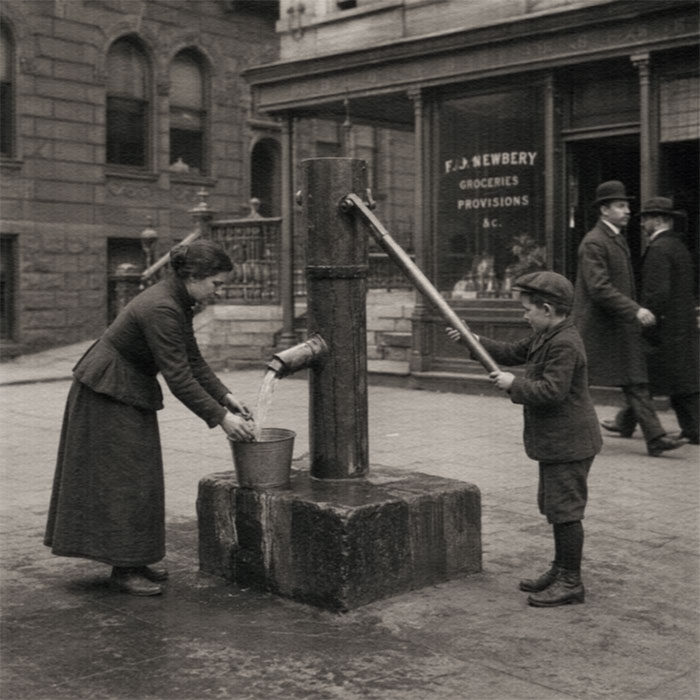
For households, getting water was a daily task. A family might carry buckets from a well, spring, or public pump, then store that water in containers for cooking, washing, and drinking. The quality of the water depended heavily on the source and on what was happening nearby. A shallow well close to a privy, livestock area, or waste dump could become contaminated without anyone realizing it.
Early Americans had no modern germ theory to explain why some water made people sick. Clear water could still contain disease-causing organisms, while cloudy water might seem suspicious even when its danger came from something else. This gap in knowledge shaped drinking-water history for generations.
As towns became larger and denser, hauling water by hand became less workable. Fire protection also became a major concern. Communities needed larger supplies that could reach homes, businesses, streets, and fire crews with greater speed and consistency. Those pressures helped push American cities toward public water systems.
The Growth of America's First Public Water Systems
Some early American cities had private water companies, but municipal systems became increasingly important during the late 1700s and early 1800s. Philadelphia offers one of the best-known examples. The city began supplying water through a city-owned system in 1801, after repeated yellow fever epidemics and growing concern about sanitation, firefighting, and household water needs. Water came from the Schuylkill River and was pumped into the city. Philadelphia was among the earliest U.S. cities to treat water supply as a municipal responsibility.
Early systems were far simpler than modern networks. Cities used reservoirs, gravity-fed lines, wooden pipes, iron pipes, steam-powered pumps, and public hydrants. Some homes had direct connections, while many residents still carried water from shared outlets.
The rise of public waterworks changed daily life, yet it also brought a new problem. A single contaminated source could now expose large numbers of people. As cities grew during the 1800s, sewage, industrial waste, animal waste, and street runoff entered rivers and other water sources used for drinking. Public water supply had become easier to distribute, but safe treatment hadn't yet caught up.
Urban Growth, Pollution, and Waterborne Disease
The 19th century brought rapid urban growth across the United States. Dense neighborhoods, factories, horse traffic, poor sewer systems, and growing volumes of human waste placed heavy pressure on local waterways. Many cities drew drinking water from the same rivers that received sewage and industrial discharges.
This had serious health effects. Cholera and typhoid fever became feared diseases in American cities, and contaminated drinking water was a major route of transmission. Scientists and public health officials gradually learned that microorganisms in water could spread illness, a finding that changed the way cities approached water supply.
By the late 1800s, the link between sewage pollution and disease was becoming much clearer. City leaders could no longer judge water mainly by appearance, smell, or taste. A supply could look clean and still carry harmful microbes.
That shift in understanding changed public policy and engineering. Protecting source water gained importance, sewer systems improved, and cities began using treatment methods aimed at removing contamination before water entered distribution pipes. The move toward filtration and disinfection became one of the biggest turning points in U.S. public health.
The Beginning of Drinking Water Treatment
Filtration came first in many American systems. Slow sand filters and later rapid sand filtration helped remove suspended material and reduced many microorganisms. Treatment plants also used settling and other steps to remove particles before water reached consumers.
Disinfection brought an even larger change. In 1908, Jersey City, New Jersey, became the first U.S. city to begin routine disinfection of community drinking water. Thousands of cities and towns followed during the next decade. The spread of chlorination, paired with filtration, better sanitation, and cleaner source water, sharply reduced waterborne disease.
The change can be seen in typhoid statistics. According to the CDC, the U.S. typhoid rate was about 100 cases per 100,000 people in 1900. By 1920, it had fallen to 33.8 cases per 100,000. Water disinfection and treatment were major parts of that decline, along with better sewage handling and hygiene.
Water treatment methods grew more refined as engineers learned how water chemistry, sediment, microbes, and distribution systems interacted. Public water plants began to use several treatment stages, with each step serving a different purpose. By the 20th century, safe tap water was becoming a normal part of urban life rather than a service limited to certain neighborhoods or households.
Municipal Water Systems Spread Across the Country
During the early and middle decades of the 20th century, municipal water networks reached a much larger share of the U.S. population. Cities and suburbs added treatment plants, pumping stations, storage tanks, reservoirs, water towers, and miles of underground mains.
Indoor plumbing also became far more common. Running water changed household routines because families no longer had to carry every bucket used for drinking, cooking, washing, and bathing. Water service also supported flush toilets, household sanitation, firefighting, hospitals, schools, restaurants, and growing industries.
The system Americans now recognize as public tap water took shape during this period. Water was drawn from rivers, lakes, reservoirs, or groundwater, treated at a plant when treatment was required, stored, and sent through pressurized pipes to buildings.
Growth brought long-term costs as well. Pipes, pumps, tanks, and treatment plants have finite service lives. Many parts of the water infrastructure still in use during the 21st century were installed decades ago. This legacy explains why pipe replacement, corrosion control, leakage, and infrastructure funding remain major drinking-water issues.
Private Wells and Rural Drinking Water
Public water systems never reached every American household. In rural and less densely populated areas, private wells remained a common source of drinking water. Early wells were commonly dug by hand and were relatively shallow. Over time, drilled wells became common, allowing households to reach deeper groundwater supplies.
Mechanical and electric pumps changed private-well use considerably. A modern home well can pump groundwater into a pressure tank and household plumbing, giving residents running water without a municipal connection. This setup became a standard part of rural housing in many areas.
Private wells occupy a different legal position from public systems. The federal Safe Drinking Water Act doesn't regulate individual private wells, and owners generally carry responsibility for maintenance and water-quality testing. USGS has reported that tens of millions of Americans rely on domestic wells for drinking water.
Groundwater can be very clean, but its quality varies by geology, land use, well construction, and nearby contamination sources. Private wells may contain naturally occurring substances such as arsenic or manganese, while nitrate, bacteria, pesticides, or other pollutants can enter groundwater from human activity. Since private wells generally aren't monitored like public systems, testing remains an important part of well ownership.
The history of private wells also shows why the U.S. has never had a single drinking-water system. Municipal tap water and privately supplied groundwater developed side by side, and both remain major parts of American water use.
Fluoridation and Changes in Public Water Treatment
By the middle of the 20th century, drinking-water treatment was moving beyond the basic goals of removing visible material and controlling infectious disease. Water chemistry became a larger part of public health policy, and community water fluoridation became one of the most widely discussed changes.
Research during the early 20th century found a relationship between naturally occurring fluoride in water and lower rates of tooth decay. On January 25, 1945, Grand Rapids, Michigan, became the first U.S. city to add fluoride to its public water supply as part of a planned study. Other communities followed as researchers gathered data on dental health.
By 1950, the U.S. Public Health Service and major dental organizations supported community fluoridation. Use grew rapidly during the 1950s and later decades, although local debate continued in many communities. Fluoridation decisions have generally remained under state and local authority, and the federal government doesn't require every public system to fluoridate its water.
At the same time, utilities became more attentive to pH, corrosion, hardness, taste, odor, and the chemical reactions that occur during treatment and distribution. Modern water treatment developed as a layered process in which source quality, filtration, disinfection, chemistry, and pipe conditions all play a role.
Drinking Water Contaminants Gain Greater Attention
Early public water programs focused heavily on microbes because diseases such as cholera and typhoid could spread quickly. As science improved, concern about water contaminants widened to include chemicals and metals that could cause harm after long periods of exposure.
Lead became one of the best-known examples. Lead service lines were installed mainly from the late 1800s through the 1940s, especially in older cities. Lead can enter tap water when pipes, solder, faucets, and fixtures containing lead corrode. The problem may arise within the distribution system or building plumbing, even when water leaving a treatment plant meets water-quality standards.
Arsenic brought a different type of concern because it can occur naturally in groundwater. The federal arsenic limit for public drinking water was 50 parts per billion for decades. EPA adopted a 10-parts-per-billion standard in 2001, with systems required to meet it by January 2006.
Nitrate is another long-standing concern, especially in groundwater influenced by fertilizer, manure, septic systems, or other nitrogen sources. Federal drinking-water rules also cover many industrial chemicals, volatile organic compounds, synthetic organic chemicals, radionuclides, and microbial contaminants. EPA's chemical rules now address over 65 contaminants across several chemical groups.
This broader view of contamination changed how Americans understood drinking-water safety. A glass of water could carry risks that had no visible sign, no unusual taste, and no immediate illness. Laboratory testing and enforceable standards became central parts of public water management.
Federal Drinking Water Regulation
For much of U.S. history, drinking-water oversight came mainly from states, cities, and public health agencies. Federal involvement grew during the 20th century as research uncovered wider contamination problems and as public water systems served larger populations.
Congress passed the Safe Drinking Water Act in 1974. The law gave EPA authority to set national health-based standards for public drinking-water systems and built a federal-state structure for oversight. It covers public systems that meet federal definitions, while individual private wells remain outside the law's direct regulation.
The law changed significantly in 1986 and 1996. The 1986 amendments required standards for additional contaminants, strengthened enforcement, added groundwater protections, and prohibited lead pipes, solder, and flux in public water systems. The 1996 amendments placed greater attention on source-water protection, operator training, funding, risk assessment, and public information.
EPA later added or revised rules as science advanced. The 1989 Surface Water Treatment Rule required filtration and disinfection for many public systems using surface water, with limited exceptions for systems meeting specific source-protection and water-quality criteria. The Lead and Copper Rule arrived in 1991 and focused on reducing lead and copper exposure from plumbing and distribution materials.
Federal rules also changed the relationship between utilities and consumers. Public systems had to monitor regulated contaminants, meet federal limits, report violations, and provide water-quality information. Drinking water had become a regulated public-health service backed by national standards rather than a patchwork based mainly on local custom.
Bottled Water, Home Filtration, and Changing Consumer Habits
During the late 20th and early 21st centuries, Americans gained many alternatives to drinking directly from the tap. Bottled water became a major consumer product, and household water-treatment devices became common in kitchens and utility rooms.
Bottled water follows a different regulatory path from municipal tap water. EPA regulates public drinking-water systems, while the Food and Drug Administration regulates bottled water as a food product. FDA rules cover sanitary processing, source protection, testing, and manufacturing conditions.
Home filtration also grew into a large consumer category. Pitcher filters, faucet-mounted filters, refrigerator cartridges, under-sink units, reverse-osmosis systems, water softeners, and whole-house treatment systems gave households greater control over taste and certain contaminants.
People use these products for many reasons. Some dislike chlorine taste or mineral content. Others have a private well, older plumbing, hard water, or a contaminant they want to reduce. Increased public access to water-quality reports and testing has also made consumers more aware of what may be present in their drinking water.
Home treatment doesn't replace public regulation, and no single filter removes every type of contaminant. The growth of filtration does, however, mark a clear shift in American drinking-water habits. Many households now treat drinking water at the point where they use it, even when the home already receives treated municipal water.
Drinking Water in the United States Today
American drinking water has changed greatly from the days of shared wells, public pumps, and untreated river water. Most people served by public systems now receive water managed under federal and state standards, while millions of private-well users remain responsible for their own systems and testing.
Current concerns have deep historical roots. Aging mains and service lines come from earlier periods of rapid construction. Lead remains tied to plumbing materials installed many decades ago. Groundwater contamination can stem from natural geology, agriculture, industry, waste disposal, and development that occurred over long periods.
Newer concerns have joined those older problems. PFAS have received major federal attention, and EPA issued the first national drinking-water regulation for several PFAS in 2024. As of 2026, EPA has proposed keeping federal limits for PFOA and PFOS while reconsidering parts of the rule covering several other PFAS.
The near-term focus is likely to stay on replacing lead service lines, repairing aging systems, improving treatment where contaminants are found, protecting groundwater and surface-water sources, and updating rules as scientific knowledge changes. Drinking-water history shows that progress has usually come through steady improvements in sanitation, engineering, testing, treatment, and public-health standards.
The history of drinking water in the United States is closely tied to the growth of cities, advances in medicine, engineering changes, and stronger public-health laws. Americans moved from carrying water from wells and rivers to using large public systems capable of treating and distributing billions of gallons.
That change took generations. Filtration and chlorination reduced deadly waterborne disease, municipal networks brought running water to homes, private-well technology improved rural water access, and federal rules brought national standards to public systems. Later attention to lead, arsenic, nitrate, industrial chemicals, and PFAS showed that drinking-water safety keeps changing as science learns more about long-term exposure.
The basic goal, however, has stayed remarkably consistent: provide water people can drink with confidence. The methods used to reach that goal have grown far more advanced, and the history behind them explains why modern drinking water depends on careful treatment, testing, maintenance, and oversight.