



A Detailed Comparison of Plumbing Materials
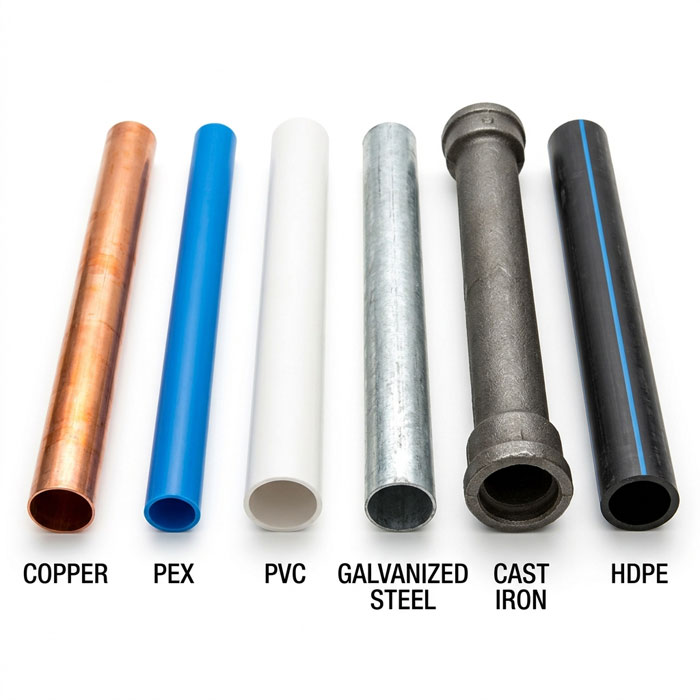
This guide compares common plumbing pipe materials, including copper, PEX, PVC, CPVC, galvanized steel, cast iron, ABS, and others, explaining uses, lifespans, costs, advantages, drawbacks, and key differences for homeowners.
Understanding the Main Types of Plumbing Materials
Plumbing pipes have changed considerably over the years. Older homes may contain galvanized steel, cast iron, brass, or even lead service lines, while newer construction commonly relies on copper and several types of plastic piping. Some materials have remained popular for decades, while others have largely disappeared from new residential plumbing.
Each material has characteristics that make it better suited to certain plumbing jobs. Some handle pressurized hot water well, some resist corrosion, and others are primarily intended for drains and vents. Pipe weight, flexibility, temperature limits, installation methods, water chemistry, and cost also vary considerably from one material to another.
There isn't one plumbing material that works best for every application. A homeowner comparing pipe types will usually find that each offers a different balance of lifespan, price, strength, ease of installation, and resistance to common plumbing problems.
Understanding those differences can make conversations about repairs, repiping, renovations, and new plumbing systems much easier. It also helps explain why a plumber may recommend one material for a water line and another for a drain or underground service line.
Copper Pipes
Copper has been used for residential plumbing for many decades and remains one of the best-known materials for hot- and cold-water supply lines. It can be installed inside walls, beneath floors, in basements, and in many other parts of a building's water-distribution system.
Copper water tubing is commonly sold as Types K, L, and M. Type K has the thickest wall, Type L has an intermediate wall thickness, and Type M has the thinnest wall. The correct type depends on the application and plumbing code. Copper DWV tubing is a separate product intended for drain, waste, and vent piping.
One of copper's biggest advantages is its long service history. Guidance from the U.S. Department of Housing and Urban Development (HUD) lists a normal service life of 50 years or longer for copper plumbing. Actual life can vary substantially according to water chemistry, pipe quality, installation, pressure, and other conditions.
Copper also handles high water temperatures well and isn't damaged by ultraviolet light. Its rigid construction provides sturdy piping, and its smooth interior tends to resist the heavy mineral restriction associated with aging galvanized steel.
Cost is one of copper's main disadvantages. The pipe itself generally costs considerably more than PEX or common plastic piping, and installation can require additional labor. Traditional copper installation may involve cutting, fitting, cleaning, and soldering joints, although press-connect systems provide another connection method.
Copper can corrode under certain water conditions. Water chemistry plays a major role, particularly when water is acidic or otherwise corrosive. EPA states that water acidity, mineral content, temperature, pipe wear, and several other factors can influence corrosion of plumbing materials.
Pinhole leaks can develop in copper plumbing as it ages, especially when conditions inside the system contribute to corrosion. Copper is also less forgiving of freezing than flexible plastic tubing. Water that freezes and swells inside a copper pipe can cause the pipe to split.
Even with those drawbacks, copper remains a durable choice for residential water distribution. Its combination of heat resistance, long service life, and decades of use gives homeowners and plumbers a substantial performance record to consider.
PEX Pipes
PEX stands for cross-linked polyethylene. It is flexible plastic tubing designed for plumbing applications and has become a common alternative to rigid copper or CPVC water lines.
PEX is mainly used for hot- and cold-water distribution. Because the tubing bends, it can travel around many corners and obstacles without requiring an elbow fitting at every change in direction. Long continuous runs may reduce the number of joints hidden inside walls and floors.
PEX is commonly identified as PEX-A, PEX-B, or PEX-C. Those letters describe the manufacturing method rather than serving as a simple best-to-worst ranking. Installation methods, fittings, flexibility, and other characteristics can differ among products.
A major advantage is installation speed. PEX is light, easy to carry, and much easier to route through framing than rigid pipe. Depending on the system, connections may use expansion fittings, crimp rings, clamps, or other approved fittings. Because several connection systems exist, components have to be compatible with the tubing and installation method being used.
PEX doesn't rust or develop metal corrosion. Its flexibility also gives it some ability to swell when water freezes inside it, which can reduce the chance of a burst compared with rigid pipe. That doesn't make PEX freeze-proof. Frozen fittings, severe cold, repeated freezing, and other conditions can still lead to damage.
PEX systems are designed for long-term service. Plastics Pipe Institute materials discuss a 50-year anticipated design life for PEX under specified temperature and operating conditions. Actual life varies with temperature, pressure, water chemistry, installation, and product specifications.
Sunlight is an important limitation. PEX can deteriorate after excessive ultraviolet exposure, so tubing has to be stored and installed according to manufacturer limits. It generally isn't suitable for long-term outdoor exposure unless specifically protected and approved for that use.
PEX commonly costs less than copper, particularly when labor is included. Its flexibility and relatively simple installation make it especially appealing for whole-house repiping and areas where running rigid pipe would require numerous fittings.
For many residential water systems, PEX offers a useful combination of price, corrosion resistance, flexibility, and long expected life.
PVC and CPVC Pipes
PVC and CPVC are both plastic piping materials, but they aren't interchangeable.
PVC stands for polyvinyl chloride. In residential plumbing, it is strongly associated with drain, waste, and vent systems. It is also used for certain cold-water and underground applications when the pipe, installation, and local code permit that use.
PVC is light and relatively inexpensive. It doesn't rust, and its smooth interior helps wastewater move through drainage piping without the internal corrosion found in some metal systems. The pipe is cut to length and generally joined with compatible primer and solvent cement, depending on the system and local requirements.
Heat is one of PVC's main limitations. Standard PVC isn't normally used for indoor hot-water distribution because elevated temperatures can exceed its intended operating conditions.
Long-term studies of PVC water and sewer pipe support service lives exceeding 100 years under suitable conditions, though residential installations can fail much sooner when pipes are damaged, poorly supported, improperly joined, or installed incorrectly.
CPVC stands for chlorinated polyvinyl chloride. The added chlorine changes the material's temperature resistance, making CPVC suitable for hot- and cold-water distribution when the product is approved for that use. ASTM D2846 covers residential and commercial CPVC hot- and cold-water systems for water service up to 180 degrees Fahrenheit.
CPVC is corrosion-resistant, light, and generally less costly than copper. It doesn't need soldered connections, which eliminates the use of a torch during standard solvent-cement installation.
Age can bring drawbacks. Older CPVC may become brittle, particularly after years of heat exposure. A pipe that has worked without trouble for many years can sometimes crack when disturbed during nearby plumbing work. Chemical compatibility also deserves attention because certain products can damage CPVC.
Both PVC and CPVC offer strong corrosion resistance and lower material costs compared with many metals. Their intended uses differ, so the proper material has to match the temperature, pressure, and plumbing application.
Galvanized Steel Pipes
Galvanized steel piping is most commonly encountered in older homes. The steel pipe was coated with zinc to slow corrosion, making it a widely used water-supply material before copper and modern plastics became dominant.
Its greatest strength is physical toughness. Galvanized pipe is rigid, strong, and resistant to impact. When relatively new, it provided dependable pressurized water service.
The problem develops inside the pipe as the years pass. Zinc protection gradually wears away, allowing rust and mineral deposits to collect on the inner walls. The open diameter can become progressively smaller even when the outside of the pipe still appears intact.
That buildup can reduce water pressure and flow. Faucets may receive less water, and rust-colored water can appear as deterioration advances.
HUD places the service life of galvanized steel plumbing at roughly 20 to 50 years, with pipe quality, joints, and mineral content of the water among the factors influencing longevity. The same guidance identifies rust, mineral deposits, low flow, and low water pressure as common concerns with aging galvanized piping.
Galvanized steel is also heavy and labor-intensive to work with. Cutting and threading pipe takes considerably more effort than installing PEX or common plastic piping.
For those reasons, galvanized steel has largely given way to copper and plastic materials in residential water distribution. Existing galvanized plumbing can remain usable for years when it is in good condition, though widespread corrosion or restricted flow can make replacement a reasonable choice.
Cast Iron and ABS Pipes
Cast iron and ABS serve a different role from copper, PEX, and CPVC. They are primarily used for drain, waste, and vent systems rather than household drinking-water distribution.
Cast iron has a long history in drainage plumbing. It is very strong, rigid, and heavy. That weight can be inconvenient during installation, yet it provides one of cast iron's biggest benefits: sound control. Wastewater passing through cast iron tends to produce less noticeable plumbing noise than water traveling through lightweight plastic drain pipe.
Cast iron is also resistant to heat and physical damage. Modern cast iron soil pipe is made for sanitary drains, waste lines, vents, sewer lines, and storm drainage, with products available for above- and below-ground installations.
Its disadvantages include weight, labor, price, and the possibility of corrosion. Old cast iron can develop rust, scaling, thin sections, cracks, or rough interior surfaces. Soil conditions can influence buried pipe as well. The Cast Iron Soil Pipe Institute identifies soil pH, moisture, sulfides, resistivity, and other soil characteristics as factors related to underground corrosion.
Cast iron can remain in service for many decades, and some cast iron water and gas mains have remained in use for well over a century. Residential drain-pipe life varies too much to assign every installation the same replacement age.
ABS, or acrylonitrile butadiene styrene, is a rigid plastic used for drain, waste, and vent systems. It is usually black, making it easy to distinguish from white PVC in many homes.
ABS is much lighter than cast iron and relatively easy to cut and install. It resists rust and corrosion, and its low weight reduces the physical work involved in handling long pipe sections.
Its lighter construction means flowing wastewater can be easier to hear. ABS also needs proper support, suitable fittings, and installation methods that meet local plumbing requirements. Manufacturer guidance can place limits on permanent direct sunlight exposure, depending on the specific product.
ABS drain systems can remain useful for several decades when installed and used correctly. Since product formulation, installation, physical damage, and building conditions vary, age by itself isn't a reliable reason for replacement.
Other Plumbing Materials
Several additional materials may appear in residential plumbing, particularly in older homes or specialized installations.
Brass is commonly found in fittings, valves, and older piping. It is strong and handles heat well. HUD gives an approximate service life of 40 years for yellow brass and 70 years or longer for red brass. Older brass can develop pinhole leaks through a corrosion process that removes zinc from the alloy.
Stainless steel is highly resistant to corrosion and can be used for water-distribution and drainage applications when approved products and fittings are used. It is durable, though its cost generally makes it less common than copper or plastic in ordinary residential plumbing.
HDPE, or high-density polyethylene, is widely used for buried water service, drainage, and other underground piping applications. It is flexible, corrosion-resistant, and capable of long service. Research cited by the Plastics Pipe Institute supports service lives exceeding 100 years for certain HDPE drainage systems under defined conditions.
Polybutylene is an older flexible plastic water-supply material found in some homes built during the period when it was widely installed. It is no longer a normal choice for new residential plumbing in the United States. Existing systems can develop leaks at pipes, fittings, or connections as they age, so its presence deserves attention during inspections and plumbing work.
Lead may still exist in older service lines and plumbing components. It isn't considered an acceptable modern drinking-water pipe material because lead can enter the water as plumbing corrodes. EPA states that lead service lines are a major source of lead in drinking water where they remain in place, particularly in older communities and homes.
These less-common materials show how residential plumbing has changed over time. Some remain useful for particular jobs, while others are primarily encountered when older plumbing is inspected, repaired, or replaced.
How Water Conditions Influence Plumbing Materials
Pipe material is only part of the longevity question. The water moving through it can have a major influence on long-term performance.
Hard water carries dissolved minerals that may leave deposits inside fixtures, valves, water heaters, and some piping. Galvanized steel is especially prone to internal restriction as rust and mineral deposits accumulate.
Acidic or low-mineral water can increase corrosion of certain metals. EPA identifies acidity, alkalinity, mineral content, water temperature, pipe wear, and the amount of time water sits in plumbing as factors involved in corrosion.
Copper may develop corrosion under unfavorable water conditions. Lead-containing plumbing carries a greater concern because corrosion can release lead into drinking water. EPA identifies lead pipes, faucets, fixtures, and lead service lines among the common sources.
Plastic piping avoids metal rust, although it still has operating limits. Temperature, pressure, disinfectant exposure, sunlight, chemical contact, and installation quality can influence long-term performance.
Private well water can vary considerably from one property to another. pH, hardness, iron, manganese, dissolved minerals, and other characteristics may influence both plumbing and fixtures. When unexplained corrosion, staining, scale, or repeated pipe problems occur, testing the water can help identify conditions that may be contributing.
Can Different Plumbing Materials Be Used Together?
Old and new plumbing materials can usually be joined when approved transition fittings and installation methods are available.
Compatibility becomes especially important when dissimilar metals are connected. Copper and galvanized steel can undergo galvanic corrosion when they are directly joined under conditions that allow an electrical reaction between the metals. Cast iron industry guidance also identifies contact between different metals, including iron and copper or brass, as one possible contributor to galvanic corrosion.
Proper transition fittings or other approved separation methods can reduce those problems. Plastic-to-metal connections also require fittings suited to both materials and the operating conditions of the plumbing system.
Comparing plumbing materials becomes easier once the strengths and limitations of each type are clear. Copper, PEX, PVC, CPVC, galvanized steel, cast iron, ABS, and other materials all serve useful purposes under the right conditions. Lifespan, cost, water chemistry, temperature, corrosion resistance, installation needs, and intended use can point toward different choices for different plumbing jobs. Knowing those differences gives homeowners a stronger foundation for discussing repairs, replacement, or new plumbing with a qualified professional.