



What Is AFUE and What Does a Furnace Efficiency Rating Really Mean
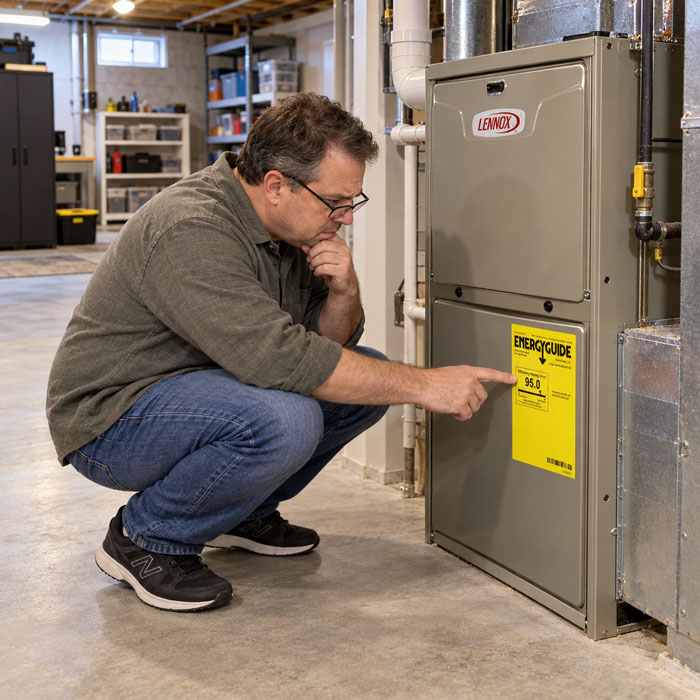
AFUE ratings help homeowners understand the efficiency, fuel use, and heating costs of fuel-burning furnaces and boilers. This article explains what those percentages mean, how they're measured, and how they relate to everyday heating performance.
What Does AFUE Mean?
AFUE stands for Annual Fuel Utilization Efficiency, and it's one of the main measurements used to describe furnace efficiency.
The rating is expressed as a percentage and shows how efficiently a furnace converts fuel into usable heat over a typical heating season. A higher AFUE percentage means the furnace uses a larger share of its fuel for heating the home.
The main purpose of AFUE is simple. It focuses specifically on fuel use and provides a consistent number that helps show how effectively a furnace turns purchased fuel into heat for the home. It gives homeowners a standard way to compare the efficiency of different furnaces without having to understand all the mechanical details behind how each model operates.
The AFUE rating, however, doesn't describe how powerful the furnace is, how quickly it can heat a house, or how evenly heat will reach different rooms. Those factors depend on other parts of the heating system, including furnace size, ductwork, airflow, insulation, thermostat settings, and the condition of the home.
AFUE also represents seasonal efficiency rather than what happens during one short heating cycle. Furnace operation changes throughout the season as outdoor temperatures rise and fall, so the rating is designed to give a broader picture of fuel use over time.
And AFUE isn't the same as a furnace's BTU rating. BTUs ("British Thermal Units") measure heating capacity, or how much heat a furnace can produce. AFUE measures how efficiently the furnace uses fuel while producing that heat. This distinction can be important when comparing equipment. Two furnaces can have similar heating capacities while carrying very different AFUE ratings. They may be capable of heating the same size house, yet one may require less fuel to provide that heat. A large furnace can have a low AFUE rating, while a smaller furnace can have a high one. Furnace size and furnace efficiency need to be considered separately when a heating system is selected.
How Is AFUE Calculated?
The AFUE rating compares the amount of useful heat produced by the furnace with the amount of fuel energy consumed. The relationship between those two figures becomes the AFUE percentage.
Suppose a furnace uses fuel containing 100 units of energy during a certain period. If 80 units become usable heat, the furnace operates at roughly 80% efficiency for that measurement. But a furnace that turns 95 of those units into usable heat would be close to 95%.
Some energy loss is unavoidable in a fuel-burning furnace. Combustion produces exhaust gases that have to leave the home safely. Heat can leave with those gases, especially in furnaces that use traditional metal flues. Higher-efficiency furnaces are designed to recover a larger portion of heat that would otherwise leave through the exhaust. Many use a second heat exchanger to pull additional heat from combustion gases before those gases are vented outside.
What Do Different AFUE Ratings Mean?
AFUE percentages give homeowners an easy way to compare the fuel efficiency of different furnaces.
An 80% AFUE furnace loses about 20% of its fuel energy during operation. A 90% model loses about 10%, while a 95% model loses about 5%. The difference can sound small when looking at a few percentage points. Over many heating seasons, though, those percentages can change the amount of fuel a home uses.
A few percentage points can become meaningful in a house that uses a large amount of heating fuel each winter. The same difference may have a smaller financial impact in a mild climate or a house with relatively low heating needs.
The AFUE percentage gives homeowners a useful comparison point, but it works best when viewed alongside fuel costs, local weather, furnace price, installation requirements, and the way the house uses heat.
Standard-Efficiency and High-Efficiency Furnace Design
Furnaces are commonly discussed in two broad groups: standard-efficiency and high-efficiency models. Many standard-efficiency furnaces operate around the 80% level. These models generally use simpler venting systems and have lower equipment costs than furnaces with ratings in the 90s. High-efficiency furnaces usually have AFUE ratings of 90% or higher. Many modern models fall around 95% or above.
The difference between an 80% furnace and a furnace rated in the 90s involves some changes in how the equipment handles combustion heat.
A typical 80% furnace uses one main heat exchanger. Hot combustion gases transfer heat through that exchanger before leaving the house through a vent or chimney. Because those exhaust gases are still fairly hot, some usable heat leaves with them.
A high-efficiency furnace usually adds a secondary heat exchanger. This allows the system to remove additional heat from the exhaust before it's vented outside. As the exhaust cools, water vapor inside it condenses into liquid. That's why high-efficiency furnaces are sometimes called condensing furnaces. That condensation has to go somewhere. These systems normally include a drain line that carries the water away.
Venting is also different. Many conventional furnaces use metal vent pipes because their exhaust remains hot. High-efficiency models commonly use plastic vent piping because their exhaust temperatures are much lower. Those design differences can influence installation cost. Changing from one furnace type to another may require new vent pipes, drainage work, or changes around the furnace location.
The equipment itself may also contain additional parts, which can influence future service costs.
Homeowners don't need to understand every mechanical detail to compare furnaces. They should, however, know that the AFUE percentage comes from actual differences in how the furnace captures and uses heat.
Older Furnaces vs. Newer Furnaces
Furnace efficiency has improved considerably over the years. Older heating systems may have AFUE ratings well below those of many current models.
Some older furnaces may operate around 60% to 70% efficiency, especially equipment that has been in service for several decades. That means a substantial portion of the fuel's energy can leave through the venting system rather than heat the home. Many furnaces installed during later periods were designed around 80% efficiency, which became a common level for conventional equipment. Newer high-efficiency furnaces can reach ratings in the 90s by capturing heat that older furnace designs allowed to escape.
Age also introduces another issue. The original AFUE rating describes how the furnace was rated when it was designed and tested. It doesn't provide a live measurement of how that furnace is operating years later. So a furnace that received an 80% AFUE rating when new won't automatically operate at exactly 80% throughout its life. Dust, worn components, airflow restrictions, combustion problems, poor adjustments, and other conditions can reduce heating performance. Regular service, though, can help a furnace operate closer to the level its design allows.
Still, age alone doesn't provide a complete picture. Two furnaces of the same age can operate differently depending on installation, service history, operating conditions, and the rest of the heating system. This is why the number printed on a furnace label is useful information, though it doesn't describe every part of the home's heating performance.
AFUE Rating vs. Real-World Furnace Efficiency
An AFUE rating comes from standardized testing. A furnace installed in a house operates under conditions that are far less controlled. That difference helps explain why homeowners shouldn't treat AFUE as an exact prediction of their annual fuel bill.
Here are some factors that can influence how efficiently a furnace operates in a home:
- The condition of the ductwork can play a major role. Heated air traveling through leaking ducts may escape before reaching the rooms where it's needed. Ducts running through colder areas can also lose heat along the way.
- Airflow matters too. A heavily clogged filter can restrict air moving through the furnace. Problems with blowers, registers, returns, or duct sizing can also change how well heat moves through the house.
- Installation quality has an important role as well. A high-efficiency furnace that's poorly sized or installed may perform less effectively than its AFUE label suggests.
- Furnace sizing is especially important. A unit that's too large may heat the house quickly and shut down, then repeat that cycle again and again. Frequent cycling can reduce comfort and may waste energy. A furnace that's too small may run for long periods during very cold weather. Proper sizing allows the heating system to work in a steadier, controlled way.
- Thermostat use also changes fuel consumption. A home kept at 74 degrees throughout winter will generally require additional heat compared with the same home kept several degrees cooler.
AFUE is still useful because every furnace is tested under a common system, making side-by-side efficiency comparisons much easier. But the rating doesn't predict exactly how efficiently a furnace will operate after it's installed, since actual performance depends on the house, heating system, outdoor temperatures, and household heating habits.
How Does AFUE Influence Heating Costs?
Higher furnace efficiency can reduce fuel use because a larger portion of each unit of fuel becomes usable heat.
Consider two furnaces serving the same house under similar conditions. One has an AFUE rating of 80%, and the other is rated at 95%. The 95% furnace needs less fuel to provide the same amount of useful heat. That doesn't mean the household's heating bill will drop by 15%. The percentages don't work that way because the comparison is based on fuel input and heat output.
For example, replacing an 80% furnace with a 95% model reduces the fuel needed to produce the same amount of heat by roughly 16%, assuming other conditions remain similar. Actual household savings can be different.
- Fuel prices have a large influence on the dollar value of improved efficiency. When natural gas, propane, or oil prices are high, reducing fuel consumption can have a greater financial benefit.
- Climate is another major factor. A furnace in a cold area may run for many hours during winter. Small efficiency gains can add up over a long heating season. A house in a milder climate may use its furnace far less. Fuel savings from a higher AFUE rating may then accumulate slowly.
- Home size, insulation, air leakage, thermostat settings, occupancy patterns, and duct condition also change annual heating costs.
That's why AFUE is best used as part of a cost comparison. It tells homeowners how efficiently the furnace handles fuel, while the home's heating demand determines how much fuel will be needed in the first place.
Factors to Consider When Choosing a Heating System Based on AFUE Rating
A furnace works as part of a complete heating system, and the house itself has a strong influence on fuel consumption. Several factors can influence which AFUE rating is a good fit, including the condition of the house, local climate, fuel prices, equipment cost, and expected years of use.
Here are some parts of a home that can influence heating efficiency and fuel use.
- Insulation is one major factor. Heat moves naturally toward colder areas, so poorly insulated walls, ceilings, attics, and floors can allow heat to leave the home faster.
- Air leakage can also increase heating demand. Gaps around windows, doors, utility openings, attic access points, and other parts of the building can let warm air escape while cold air enters.
- Windows contribute as well. Older single-pane windows generally allow greater heat transfer than newer insulated units, though the condition of the frames, seals, and surrounding walls is also important.
- Ductwork deserves attention because the furnace can heat air efficiently while some of that heat is lost before reaching living areas. Leaks, disconnected sections, poor insulation, and poorly designed ducts can all reduce overall system performance.
- Furnace sizing belongs in the same discussion. A heating contractor typically considers the size of the house, insulation levels, windows, climate, air leakage, and other building details when calculating heating demand. A properly sized furnace can run in longer, steadier cycles that support even temperatures and controlled fuel use.
These factors help explain why two identical furnaces can produce different utility bills in two different homes. The AFUE rating may be the same, while each house requires a different amount of heat to stay comfortable.
The condition of the house is only one part of the decision. Fuel prices, climate, expected years of use, and equipment and installation costs can also influence which AFUE rating makes the most sense.
- The cost of the furnace should be included in the comparison. Higher-efficiency models can reduce fuel use, but they may carry higher equipment and installation costs. The extra expense has to be considered alongside the amount of fuel the furnace is likely to save.
- Local fuel prices can change the value of those savings. When natural gas, propane, or oil costs are high, using less fuel can have a greater financial benefit. When fuel costs are lower, it may take longer for the added purchase price of a higher-efficiency furnace to pay for itself.
- Climate and annual heating demand are also important. A furnace that runs heavily through a long, cold winter has a greater opportunity to save fuel than one that operates only during short periods of cool weather.
- The expected length of ownership can also influence the decision. A homeowner who plans to remain in the house for many years has a longer period to recover a higher upfront cost through lower fuel use.
A very high AFUE rating can be appealing, but higher efficiency heating systems usually cost extra. Installation may also cost extra because some models require different venting, drainage for condensation, electrical changes, or other work. The added cost should be compared with the amount of money the furnace may save on fuel over time. If a higher-efficiency model costs several thousand dollars extra but saves only a modest amount each year, recovering that difference could take many years.
Choosing an AFUE level works best when equipment price, installation cost, fuel prices, heating demand, house condition, and expected years of use are considered together. That gives a much clearer picture than focusing on the efficiency percentage alone.
AFUE gives homeowners a useful way to understand how efficiently a furnace uses fuel. An 80% rating means about 80% of the fuel's energy becomes usable heat, while higher ratings send a greater share of that energy into the home.
The percentage is valuable, but it doesn't describe the entire heating system. Ductwork, furnace sizing, insulation, air leakage, installation, thermostat settings, climate, and fuel prices all influence annual heating costs.
Higher AFUE ratings can reduce fuel use, especially in homes with long heating seasons. The highest available rating still needs to make financial sense once equipment price, installation requirements, and projected savings are considered.
Understanding what AFUE does and doesn't measure gives homeowners a clearer way to compare furnaces. Rather than focusing on a single percentage, they can look at efficiency, operating costs, home conditions, and installation needs together and choose a furnace that fits the house and budget.